
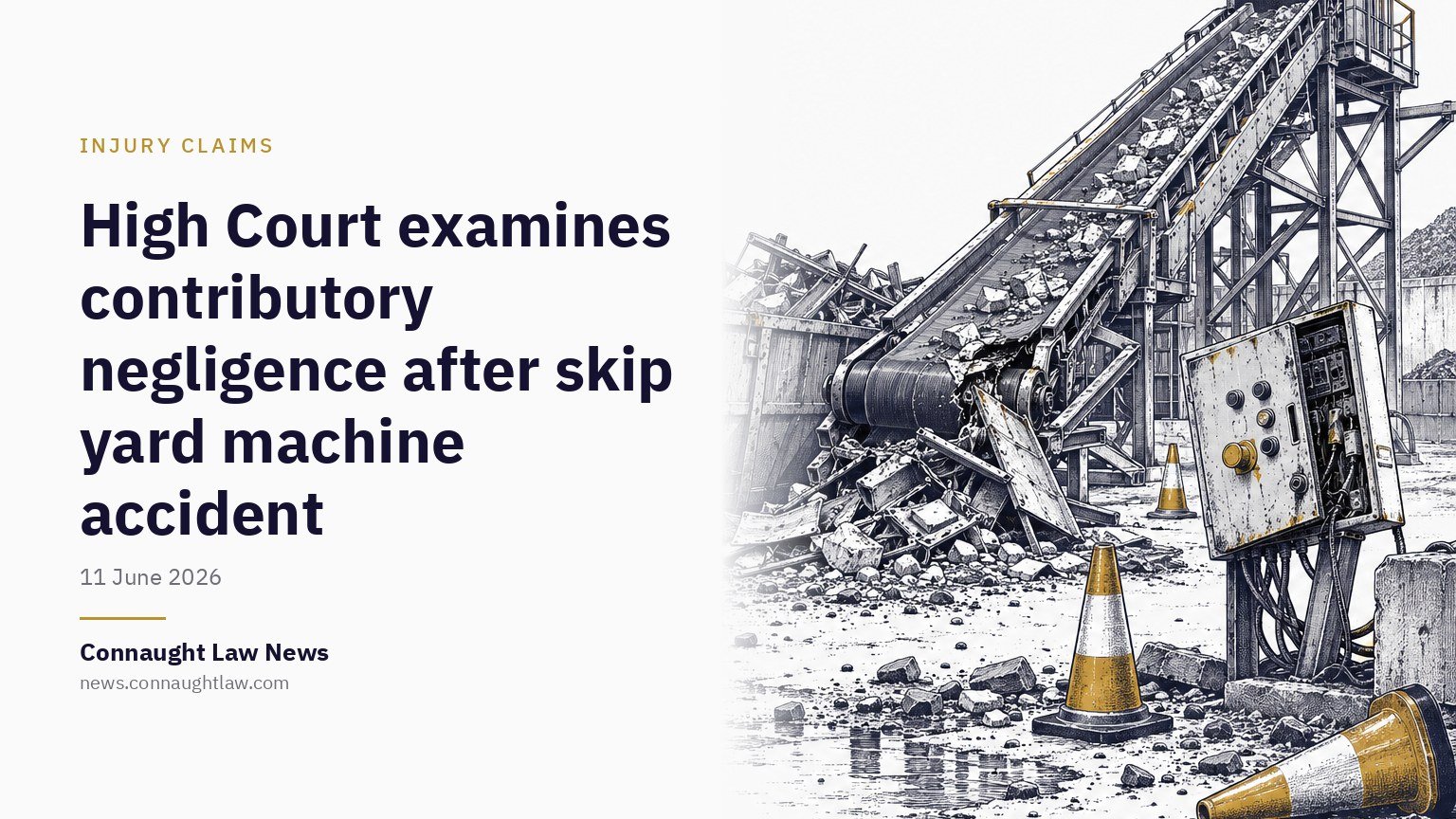
A High Court judgment of 11 June 2026 considers whether a man who had both legs amputated through the knee after a workplace accident was partly to blame for it.
Key facts
- Who: Mr Robert Geoffrey Richardson, the claimant, and William Beech Skip Hire Limited, the defendant
- From: 11 June 2026
- Source: Robert Geoffrey Richardson v William Beech Skip Hire Limited [2026] EWHC 1341 (KB)
In Richardson v William Beech Skip Hire Limited [2026] EWHC 1341 (KB), Her Honour Judge Emma Kelly, sitting as a judge of the High Court in the King's Bench Division at Birmingham, dealt with contributory negligence. The hearing took place on 7 May 2026.
Background
Mr Richardson is a director of a business that sells, services and repairs plant equipment. On or around 9 November 2024 a director of William Beech Skip Hire Limited asked him to visit its premises and measure the blades on a demolition grab fitted to a Caterpillar Waste Handler, so that replacement blades could be sourced.
While he was trying to obtain the details he needed, the grab moved suddenly, struck his legs and crushed him against the machine. All sides accept the movement happened because the company's employee, who was operating the machine, inadvertently knocked the joystick. Mr Richardson underwent bilateral through-knee amputations and also suffered an injury to his little finger and psychological injury.
He issued his claim on 4 March 2025. The company admitted primary liability, accepting it is vicariously liable for its employee's negligence, but alleged contributory negligence. On 18 July 2025 a district judge entered judgment for him with damages to be assessed and directed a trial on contributory negligence.
The question
The company alleged that Mr Richardson placed himself between the grab and the front of the machine while the engine was running and the operator was in the cab. It said he did not require the machine to be switched off or check that it was deactivated, and did not direct the grab to be moved away. It also said he did not follow his own risk assessment dated 16 October 2024, which said to make sure equipment is turned off and to isolate machinery before maintenance. The company carried the burden of proving these allegations. The accident was recorded on colour CCTV without sound, and both sides relied on it.
The legal approach
The judge set out the principles the court applies. Mere inadvertence or a momentary error by a worker may not amount to fault. The care expected depends on the circumstances, and in some circumstances failing to make sure others have done what they should is not negligent. Whether conduct is mere inadvertence or contributory negligence is a fact-specific question. In Ball v Richard Thomas & Baldwins Ltd [1968] 1 WLR 192, a 25% finding of contributory negligence was upheld against an experienced burner operator who stood less than nine feet from a moving crane.
If fault is found, the court apportions responsibility. It weighs the causative potency and blameworthiness of each side's conduct in a broad, "jury-like" and common-sense way. Comparing outcomes in other cases is, in the words of Lord Steyn in Jolley v Sutton LBC, a "sterile exercise". The company's primary case was a reduction of 40%.
What this means for those involved in contributory negligence disputes
The judgment records that the company admitted primary liability yet still contended that the claimant was partly responsible. It also shows that the court treats contributory negligence and its apportionment as fact-specific questions. Anyone involved in a workplace injury claim where this is alleged may wish to get advice on how it applies to their own circumstances before any deadline passes.
Sources
- Robert Geoffrey Richardson v William Beech Skip Hire Limited [2026] EWHC 1341 (KB), High Court (King's Bench Division), 11 June 2026: https://caselaw.nationalarchives.gov.uk/ewhc/kb/2026/1341