
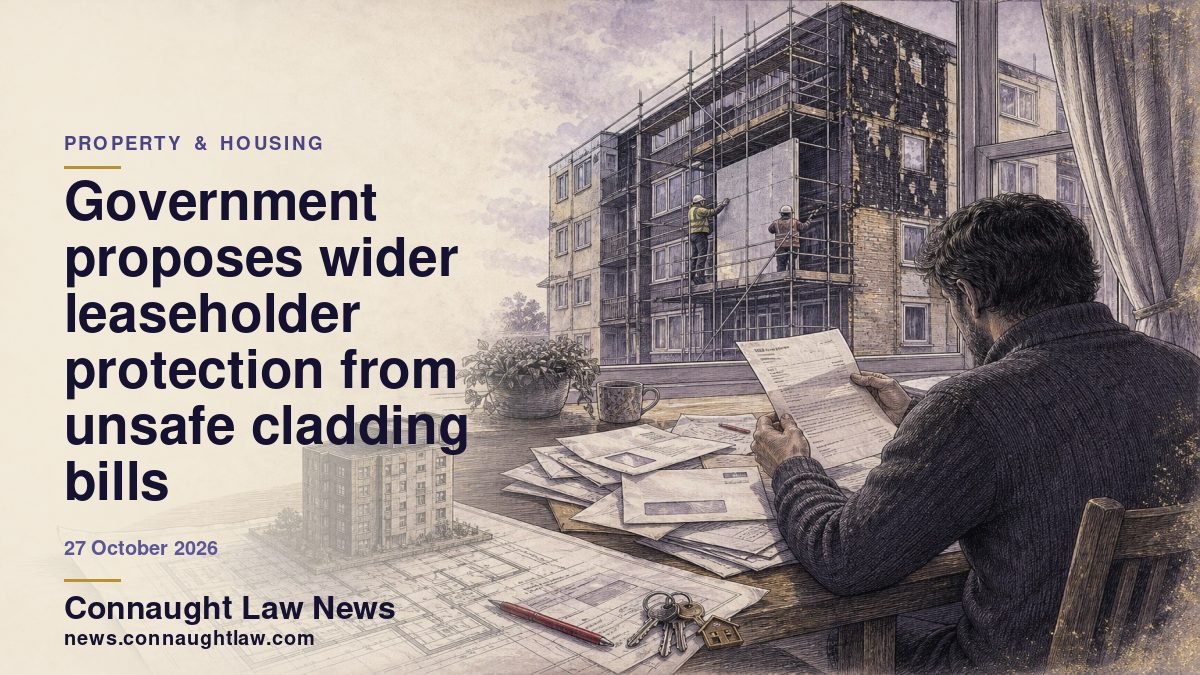
The government announced proposals on 27 October 2026 to extend protection from building safety costs to more leaseholders, including those in collectively owned and enfranchised buildings, and to make manufacturers contribute.
Key facts
- Who: Leaseholders facing bills for historic building and fire-safety defects, including those in collectively owned or enfranchised buildings, those who bought from an ineligible owner, and those who owned four to six properties
- From: 27 October 2026 (announced; the measures are proposals, with details still to come)
- Source: More people protected as government acts to make more homes safe
The government announced new proposals on 27 October 2026 to help more leaseholders at risk of high bills to fix serious building and fire-safety defects. They were unveiled in Parliament during the second reading of the Remediation of Unsafe Cladding Bill.
The gaps in current protection
Existing rules protect many leaseholders from paying for historic building safety defects. Some people still fall through gaps because of different forms of ownership the law does not cover. Whether someone is protected can depend on the circumstances of the person who owned the flat on 14 February 2022, when the protections were first published. Among other conditions, a lease can qualify where the flat was the owner's only or main home at that point, or the owner held no more than three UK properties. A lease's protected or unprotected status passes to later buyers. Someone who buys a flat as their only home can therefore still miss out if a previous owner was ineligible. The government says it is exploring how to narrow this gap.
What is proposed
- Collectively owned and enfranchised buildings: With no separate freeholder, residents are not covered by the leaseholder protections of the Building Safety Act. New government funding will help towards remediation of internal high-risk, high-cost fire-safety defects.
- Leaseholders with several properties: Protections generally cover people who owned no more than three properties on 14 February 2022. The government plans to raise the limit to six, so people who owned four to six properties and did not qualify could be protected from having non-cladding building safety costs passed on to them.
- Manufacturers: Construction product manufacturers linked to historic unsafe cladding and insulation products will be made to contribute more. The government says it will have powers to recover contributions from manufacturers at scale for the first time.
Duty to fix unsafe buildings
The Bill would place a legal duty on those responsible to fix unsafe buildings. Those who fail to act would face criminal penalties and fines of up to £500,000. Authorities could step in to get work done where those responsible consistently refuse.
Further details on eligibility and funding, and on how the manufacturer scheme will work, will be added to the Bill as it passes through Parliament or published alongside it in due course.
What this means for leaseholders
These are proposals, not yet law, and the detailed eligibility and funding rules are still to come. The groups the government says the measures are intended to help are leaseholders who bought a flat as their only home but miss out because of a previous owner's circumstances, leaseholders in collectively owned and enfranchised buildings, and leaseholders who owned four to six properties on 14 February 2022.
Sources
- More people protected as government acts to make more homes safe, GOV.UK, 27 October 2026